Multi-Agent Orchestration: Claude Code, Cursor & Codex (2026)
How to use Claude Code, Cursor, and Codex together. A 2026 guide to multi-agent orchestration with a cross-agent context layer that makes team gains compound.

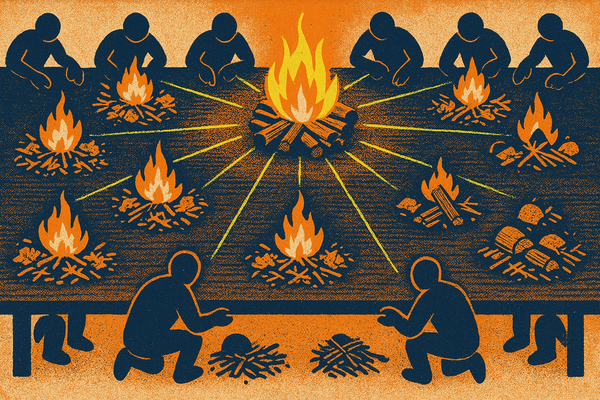
Multi-agent orchestration is the practice of coordinating multiple AI coding agents — like Claude Code, Cursor, and Codex — so their context, conventions, and work handoffs compound across your team rather than fragmenting into isolated sessions. Most engineering teams are already multi-agent whether they planned it or not, and the question has shifted from which agent should we standardize on to how do these agents work together. This guide answers that question — and builds toward ZeroShot (invoked as the bb command, at tryzeroshot.com), the cross-agent context layer that makes per-developer gains compound into per-team gains. To be clear up front: ZeroShot is not another agent. It's the memory and skills layer your agents run on top of.
Why Teams End Up Multi-Agent (Whether They Plan To or Not)
Teams become multi-agent because no single AI coding agent wins every task category. Different agents have measurably different strengths, and developers naturally gravitate toward the best tool for each job throughout the day.
- Claude Code excels at large multi-file refactors and deep codebase reasoning.
- Cursor leads on inline edits and tab-completion flow.
- Codex (and Devin) specialize in autonomous, long-running task execution.
- GitHub Copilot, Gemini CLI, and Amazon Q serve ambient suggestions and terminal-native workflows.
The data backs this up. Roughly 82% of developers report using AI coding tools at least weekly, and a majority of engineering teams now use more than one AI coding tool concurrently. AI-generated code accounts for 25–40%+ of new commits in some instrumented codebases. When that much authorship flows through multiple tools, fragmentation isn't a hypothetical — it's the default state.
The strategic mistake at team scale is single-agent maximalism: betting an entire org's workflow on one agent winning every task category. In practice, no agent dominates inline edits, autonomous runs, and large refactors simultaneously. So the real challenge isn't choosing an agent. It's designing how multiple agents coordinate.
That's where ZeroShot comes in — not as another agent to add to the pile, but as the cross-agent context layer that lets the agents you already use work together as one system.
The Hidden Cost of Multi-Agent Without an Orchestration Layer
Without an orchestration layer, multi-agent setups quietly tax your team through context fragmentation, convention drift, and broken handoffs. Each agent operates in its own silo, and the costs compound invisibly.
Where the value leaks
- Context fragments across tools. Each agent keeps its own session memory — and that memory dies the moment you close the tab. Nothing carries forward.
- No shared conventions. Cursor doesn't know the review standards your Claude Code sessions established. Every tool starts from a blank slate.
- No handoff. A teammate's Codex run can't be resumed or built on by you in Claude Code. Work doesn't transfer between people or tools.
- Onboarding pain. New engineers re-learn tribal knowledge that lives only inside individual sessions, never written down anywhere durable.
The net effect: per-developer gains don't compound into per-team gains. GitHub's research shows individual developers complete tasks up to 55% faster with AI assistance — but those individual gains don't automatically aggregate. The productivity curve flattens exactly when leadership expects it to accelerate.
Context portability is the real moat. The differentiator between high- and low-performing AI-augmented teams is whether knowledge lives in transferable artifacts — skills, resumable sessions, AGENTS.md — or in ephemeral per-developer sessions that vanish.
Orchestration is an architecture problem, not a tool-selection problem. Design the shared layer first; let the individual agents be swappable components.
The Orchestration Playbook: Which Agent for Which Job
The most effective multi-agent setup assigns each agent to its strongest task rather than forcing one tool to do everything. Use this mapping as a starting point — then keep your orchestration design agent-agnostic so you can swap tools as the landscape shifts.
| Task type | Best-fit agent(s) | Why |
|---|---|---|
| Cross-agent memory, skills & evidence | ZeroShot (bb) — the layer under all of them | Shared session memory, team conventions, and customer evidence across every agent below |
| Inline edits & flow | Cursor, GitHub Copilot | Low-latency tab completion, tight edit loop |
| Multi-file refactors | Claude Code | Strong codebase reasoning across many files |
| Autonomous PRs / long-running tasks | Codex, Devin | Runs unattended, produces drafts to review |
| Terminal-native workflows | Gemini CLI, Amazon Q | Lives in the shell, scriptable |
Decision criteria
- Task scope — single line, single file, or many files?
- Autonomy level — do you want to drive, or hand off and review later?
- Review surface — inline diff, full PR, or terminal output?
- Latency tolerance — interactive flow vs. background execution.
An honest caveat: the "best" agent shifts month to month. A tool that leads at refactors today may be eclipsed next quarter. That's exactly why your orchestration layer should be agent-agnostic. Locking into a single vendor's "for Teams" offering trades flexibility for a walled garden — you get coordination inside one tool at the cost of being unable to pick the best agent for each job. ZeroShot sits beneath whatever agents you choose, so you can swap components without rebuilding your team's knowledge layer.
How to Hand Off Work Between Agents
Handing off work between agents requires portable context — session memory that isn't trapped inside one tool. Once context travels, three handoff patterns become reliable instead of accidental.
Pattern 1: Spec in one agent, implement in another
Draft a plan in Claude Code, then execute it in Cursor. The implementation agent needs to see the plan agent's reasoning — not just the final file diff — to make good local decisions. With portable session memory, the plan travels with the work.
Pattern 2: Autonomous draft, then human-in-the-loop refinement
Let Codex produce an autonomous draft, then clean it up inline with Cursor. The refinement agent needs the draft agent's intent and the customer signal behind the change, or it polishes the wrong thing.
Pattern 3: Cross-teammate resume
This is the pattern most teams have never had access to. With ZeroShot, bb agent-sessions resume lets you pick up a colleague's agent session on your own machine — in whichever agent you prefer. A teammate's Codex run becomes your Claude Code starting point. No re-explaining, no rebuilding context, no "can you walk me through what you did?"
All three patterns depend on one thing: context that outlives the tab. And they're strengthened by a shared convention standard. AGENTS.md has emerged as a cross-agent open standard — a markdown file at the repo root, adopted by OpenAI Codex, Cursor, and others, that any compliant agent reads to learn your project's conventions. BuildBetter's open-source BB-Skills extend AGENTS.md with composable, conditionally-loaded skill packs, so conventions don't just live in a static file — they execute as slash commands inside every agent.
Keeping Conventions Consistent Across Every Agent
The most reliable way to keep conventions consistent across agents is to encode them as reusable, executable skills instead of re-typing prompts. Re-typing your review standards into each agent is convention drift waiting to happen.
BB-Skills turn your team's actual playbook into deterministic slash commands:
/bb-review— runs your real code review standards, the same way, in every agent./bb-specify— produces specs in your team's format, with customer evidence attached./bb-plan— generates implementation plans that follow your architectural conventions.
Because these skills are open source on GitHub (github.com/buildbetter-app/BB-Skills), you can adopt them, extend them, and contribute back — with no vendor lock-in. Your conventions stay yours.
Conditional loading keeps context lean
Loading every convention into every agent bloats context windows and degrades output. BB-Skills load conditionally — agents pull only the skills relevant to the task at hand. Context economy matters: a testing skill shouldn't crowd a refactor's context window.
Customer-evidence awareness
Here's a layer competing context tools don't offer: ZeroShot pulls customer evidence from BuildBetter.ai directly into specs and PR reviews. When your team writes a spec or reviews a PR, the actual customer signal — what users asked for, what they complained about — flows into the agent's context. You ship what customers requested, not what the team assumed. And it's all privacy-first: no data leaves your repo without consent.
ZeroShot as the Cross-Agent Context Layer
ZeroShot is the only context layer that combines three things at once: cross-agent session memory, team-conventional skills, and customer evidence. It's invoked as the bb command and sits beneath whatever agents your team uses.
What makes it different
- Cross-agent session memory — every chat, file edit, and tool call is saved and indexed across repo, branch, PR, and commit, and resumable on any machine in any agent.
- Team-conventional skills — BB-Skills carry your playbook into every agent as slash commands.
- Customer evidence — BuildBetter.ai signals flow into specs and reviews. This is unique to BuildBetter; pure memory tools don't have it.
ZeroShot works under Claude Code, Cursor, Codex, GitHub Copilot, Gemini CLI, Windsurf, and Amazon Q. It is explicitly not a replacement for any of them.
The honest contrast
Single-agent "for Teams" products — Cursor for Teams, Claude Code for Teams, Devin — coordinate work within one agent and lock you into a walled garden. ZeroShot is agent-agnostic and sits underneath all of them. You keep the freedom to use the best agent for each task while sharing one consistent layer of memory, conventions, and evidence.
It's used at scale by Brex, Rappi, PostHog, AppFolio, Clay, Lufthansa, Procore, and Macmillan.
And to be straight about scope: ZeroShot adds the shared layer — the agents still do the coding. If you're a solo developer using one agent, you may not need it yet. The moment you're multi-agent or multi-engineer and gains stop compounding, that's when it earns its place.
A Reference Multi-Agent Setup for a 50-Engineer Team
Here's a concrete multi-agent orchestration setup for a 50-engineer B2B SaaS team, built on ZeroShot as the shared layer.
Tool assignment
- Cursor for day-to-day inline editing and flow.
- Claude Code for multi-file refactors and architecture work.
- Codex for overnight autonomous tasks and draft PRs.
- ZeroShot (
bb) as the layer beneath all three — memory, skills, evidence.
Shared infrastructure
- Skills repo: a team fork of BB-Skills with
/bb-review,/bb-specify, and/bb-plantuned to your conventions, checked into version control. - Session-memory layer: every agent session indexed by repo, branch, PR, and commit — resumable across teammates.
- Handoff conventions: spec in Claude Code → implement in Cursor; autonomous draft in Codex → refine in Cursor; resume any teammate's session with
bb agent-sessions resume.
Onboarding flow
A new hire inherits the team's skills and resumable sessions on day one. Instead of weeks of tribal-knowledge absorption, they run /bb-review and get the team's actual standards immediately — and can resume real prior sessions to learn how decisions were made.
Metrics to watch
- Handoff latency — time to pick up another engineer's or agent's work.
- Convention drift — variance in how reviews and specs are applied across agents.
- Duplicate context-rebuilding — time spent re-explaining what an agent already knew.
Rollout sequence
- Start with shared skills — fastest visible win, low risk.
- Add session memory — enable cross-teammate resume.
- Integrate customer evidence — wire BuildBetter.ai signals into specs and reviews.
Frequently Asked Questions
What is multi-agent orchestration in AI coding?
Multi-agent orchestration is coordinating multiple AI coding agents — like Claude Code, Cursor, and Codex — so that context, conventions, and work handoffs are shared across them rather than siloed inside each tool. The goal is to make team productivity compound: each engineer's and each agent's output builds on the others' instead of fragmenting.
Can I use Claude Code, Cursor, and Codex together?
Yes. The most effective approach is to assign each agent to its strongest task — Claude Code for large refactors and codebase reasoning, Cursor for inline edits and flow, Codex for autonomous long-running tasks — and use a shared context layer like ZeroShot (the bb command) so session memory and conventions stay consistent across all of them.
Do I need a context layer, or is one agent enough?
For solo work, a single agent is usually sufficient. Teams need a shared context layer once individual productivity gains stop compounding — when context fragments across tools, conventions drift, and engineers can't pick up each other's work. That tipping point typically arrives as soon as more than one agent or more than a handful of engineers are involved.
How is ZeroShot different from Cursor for Teams or Claude Code for Teams?
Cursor for Teams and Claude Code for Teams are single-agent walled gardens — they coordinate work only within their own tool. ZeroShot is agent-agnostic and sits underneath all of them, providing cross-agent session memory, shared skills, and customer evidence that work whether you're in Claude Code, Cursor, Codex, Copilot, Gemini CLI, Windsurf, or Amazon Q.
Is ZeroShot another AI coding agent?
No. ZeroShot is not an agent and doesn't write code on its own. It's the context/memory and skills layer — invoked as the bb command — that the agents you already use run on top of. The agents still do the coding; ZeroShot makes their output consistent, portable, and customer-aware.
How does cross-teammate session resume work?
Running bb agent-sessions resume picks up any teammate's saved session on your own machine, in whichever agent you prefer. A colleague's Codex run can become your Claude Code starting point — no re-explaining, no rebuilding context.
Ship at the speed of insight.
Your team is already multi-agent. The only question is whether those agents compound your team's knowledge or fragment it. ZeroShot is the cross-agent context layer — memory, skills, and customer evidence — that makes Claude Code, Cursor, Codex, and the rest work together as one system.